

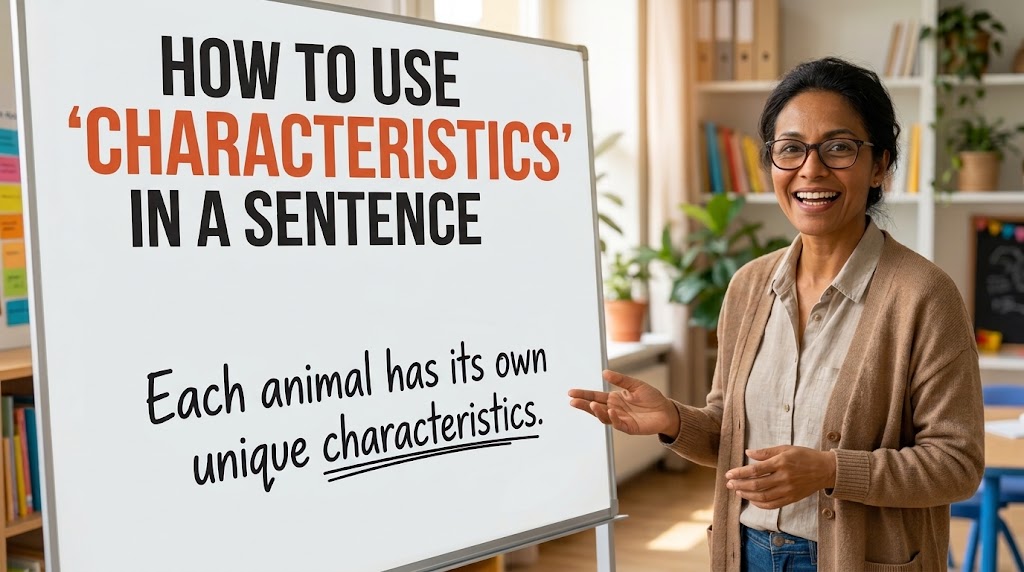
Need characteristics in a sentence you can actually copy? You’re in the right place. Below you’ll find a clear meaning, noun and adjective rules, 10 ready-to-use examples, and quick grammar tips so your essays, emails, and assignments sound natural.
What is the Meaning of Characteristic?
A characteristic (noun) is a special quality or feature that makes a person, place, or thing easy to recognize, while characteristic (adjective) describes something that is typical of a specific person or thing.
The plural, characteristics, is the form you’ll use most often when listing identifying traits. According to the Cambridge English Dictionary, the word functions as both a noun and an adjective. That double role is exactly where learners get tangled, so let’s take them one at a time.
Characteristic as a Noun
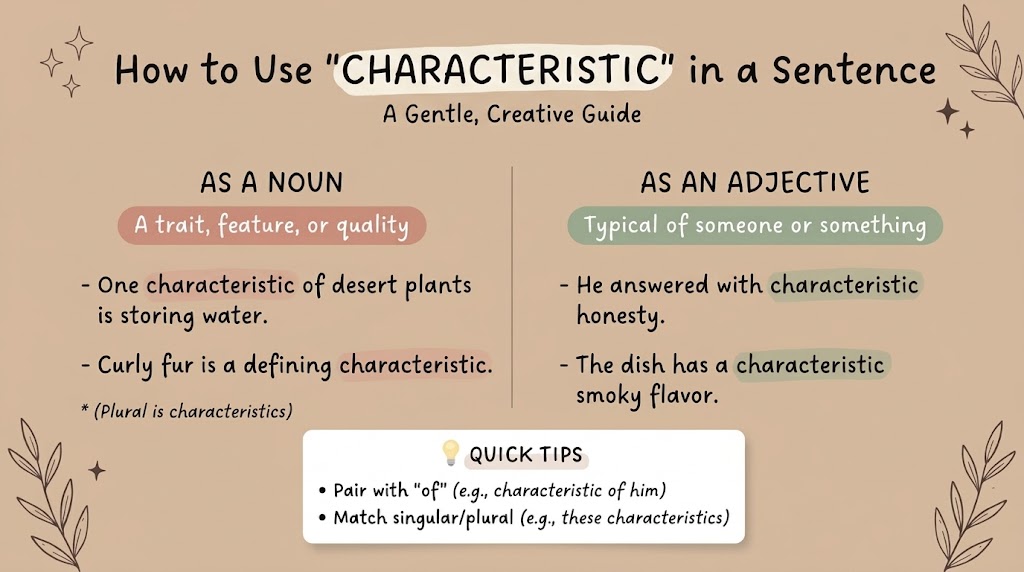
As a noun, a characteristic is a quality that makes someone or something recognizable. Think of words like “trait,” “attribute,” or “feature.”
- Generosity is her most admirable characteristic.
- One characteristic of desert plants is their ability to store water.
- Curly fur is a defining characteristic of this dog breed.
Characteristic as an Adjective
As an adjective, it describes something typical of a person, place, or thing. It almost always points to a specific behavior, style, or flavor.
- He answered the difficult question with characteristic honesty.
- The dish has the characteristic smoky flavor of the region.
- She greeted us with a characteristic grin before walking away.
10 Examples of “Characteristics” in a Sentence
Here’s the part you came for. These sentences cover everyday talk, school writing, and professional settings. Copy them, tweak them, and make them yours.
- Curiosity and patience are two characteristics of a good scientist. (academic)
- The characteristics of a healthy ecosystem include clean water and diverse species. (academic)
- When I describe my best friend, I put loyalty and humor at the top of her characteristics (everyday)
- Please review the product characteristics in the technical manual before ordering. (professional)
- Bright colors are among the defining characteristics of her artwork. (everyday)
- Teachers should adapt each lesson to the learning characteristics of their students. (academic)
- The report compares the economic characteristics of three major cities. (professional)
- Dogs share certain characteristics with wolves, from pack behavior to sharp senses. (everyday)
- Strong leadership characteristics—empathy, clarity, and a little nerve—can’t be faked for long. (professional)
- Which characteristics make this candidate stand out from the rest of the applicants? (professional)
Specific Examples of “Characteristic” in Context
Some phrases get searched on their own because they belong to specific fields of study, so they deserve their own spotlight. Two of them come up constantly.
Physical characteristics in a sentence
Physical characteristics describe how something looks, feels, or is biologically built. You’ll meet them in biology class, crime reports, and product descriptions.
- Height, eye color, and hair texture are common physical characteristics.
- The physical characteristics of this duck include webbed feet and a long, flat bill.
- Witnesses described the suspect’s physical characteristics to the police officers.
- Granite’s physical characteristics—hardness, density, and grain—make it perfect for countertops.
Demand characteristics in a sentence
This phrase belongs specifically to psychology. Demand characteristics are subtle cues in an experiment or study that hint at what the researcher expects. Participants then change their behavior to match it, often without noticing.
- Researchers used a double-blind design to reduce demand characteristics.
- Demand characteristics can quietly distort survey results when people try to please the researcher.
- The participants guessed the hypothesis, so demand characteristics may have skewed the data.
How Do You Use Characteristics in a Sentence? (Rules & Tips)
Good news: the grammar is friendlier than it looks. Master these three habits and they will cover about 95% of your writing situations.
- Match singular and plural: Use the singular characteristic with words like “a,” “one,” or “each” (“Each characteristic is useful”). Use the plural characteristics with “these,” “many,” or “several” (“These characteristics are rare”).
- Pick the right preposition: Most of the time you’ll want to pair it with “of” or “in.” For example: “the characteristics of a good leader,” or “they share characteristics in common.” When used as an adjective, it almost exclusively pairs with “of”: “That reply is characteristic of him.”
- Don’t overuse it: Here’s my honest take as a writer: characteristics is a long, heavy word that can sound stiff in casual writing. For people, words like “traits” or “qualities” feel warmer. For software or products, “features” usually wins. Save characteristics for moments that call for a formal, precise, or academic tone.
- Side note: I still remember a teacher circling this word in red pen on one of my first college essays, with a note that just said, “Again?” Fair. I had used it four times in one paragraph… and yes, it stung. Vocabulary variety matters!
Frequently Asked Questions
A common example is honesty in a person: “Honesty is her best characteristic.” It can also describe objects or places, like the sweet taste of a mango or the freezing climate of Antarctica. Anything that helps define or identify something counts.
A characteristic of something is a specific feature, quality, or trait that helps identify or describe it. For example, feathers are a characteristic of birds, and low rainfall is a characteristic of deserts. It simply answers the question, “What is this thing like?”
Character refers to a person’s overall moral nature, or a fictional role in a story (e.g., “She has a strong character”). A characteristic is just a single trait or feature that makes up that person or thing (e.g., “Patience is her best characteristic”).