

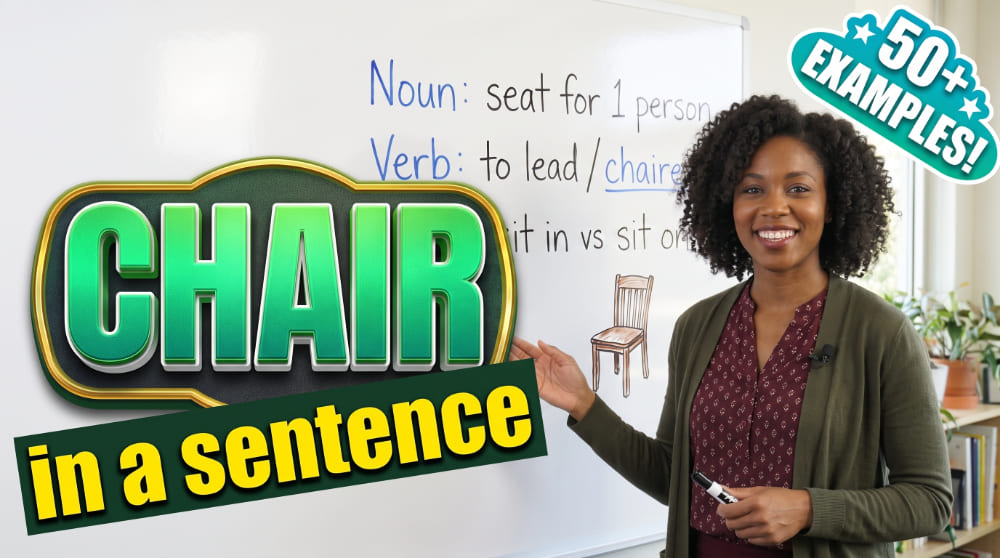
A chair is a seat for one person (plural: chairs). It’s also a person who leads a meeting—and, yes, it functions as a verb. Whether you are an English learner building your vocabulary or a student looking for homework help, below you’ll find 50+ examples of chair in a sentence.
They are sorted by meaning and part of speech, so you can copy, learn, and use them right away.
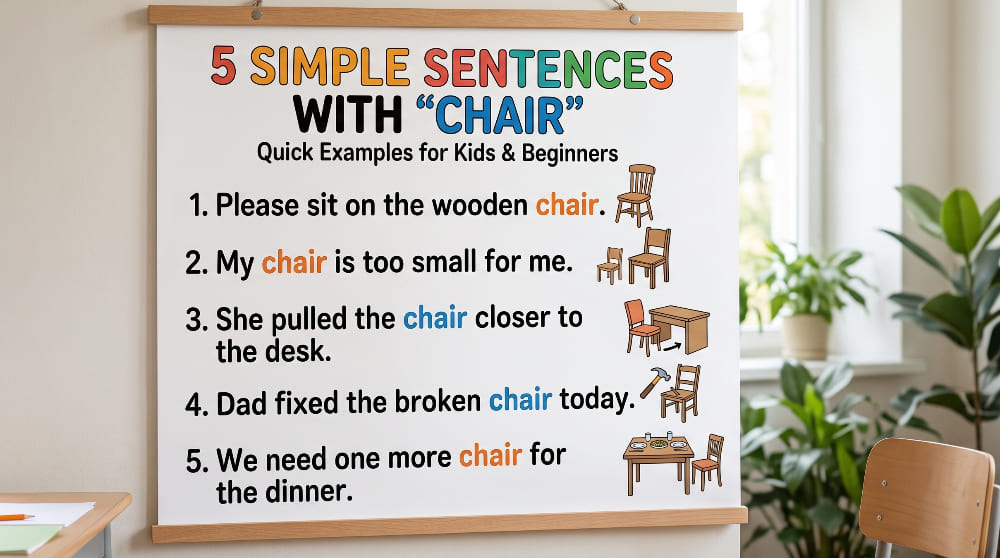
5 Simple Sentences with “Chair” (Quick Examples for Kids & Beginners)
Short on time? Start here. This is chair in a sentence at its simplest: short, clear, and easy to read out loud.
- Please sit on the wooden chair.
- My chair is too small for me.
- She pulled the chair closer to the desk.
- Dad fixed the broken chair today.
- We need one more chair for dinner.
Examples of “Chair” as a Noun in a Sentence
“Chair” is a common noun. It names an object (a piece of furniture) or a role (the person in charge). It has the exact same spelling, but the context tells you which meaning is being used.
As a Piece of Furniture (Everyday Context)
Here are the sentences you’ll use most frequently at home, at school, and in daily life.
- I left my keys on the kitchen chair.
- The teacher asked him to push in his chair.
- This office chair squeaks every time I lean back.
- We bought four chairs for the new dining table.
- The cat jumped onto the empty chair and fell asleep.
- Grandma’s rocking chair has been in our family for decades.
- Could you bring an extra chair from the garage?
- The kids built a fort out of blankets and chairs.
- A folding chair is perfect for a small apartment.
- He stood on a chair to reach the light bulb.
- There wasn’t a single free chair in the waiting room.
- Reading by the window, she curled up in her favorite chair.
As a Leader or Head of a Committee (Formal/Business Context)
In business, academic institutions, and clubs, a chair is the person who runs the group. This unique meaning comes from an official seat of authority; you can explore thehistorical origin of the word chairto see how the term evolved from the Latin cathedra. Today, many organizations also use “chairperson” to sound more gender-neutral.
- The board needs a new chair by January.
- Ms. Lopez is the chair of the finance committee.
- The chair called the meeting to order at nine.
- Please send your questions to the chair before Friday.
- When the vote is tied, the chair decides.
- The club elected Maya as its youngest chair ever.
- Our department chair approved the new schedule.
Examples of “Chair” as a Verb in a Sentence (Define “Chaired”)
As a verb, to chair means to lead, preside over, or run a meeting, panel, or committee. It is a regular verb: chair, chairs, chairing. The past tense is chaired.
Present tense
- She chairs the weekly team meeting.
- I chair the parent group at my kid’s school.
- Who chairs the committee this year?
- Chairing a meeting is harder than it looks.
Past tense
- She chaired the meeting yesterday.
- He chaired the panel for six years.
- We chaired the school fundraiser last spring.
Future tense
- Dr. Kim will chair tomorrow’s session.
- I’m going to chair my first meeting on Monday.
How to Use “Chair” Correctly: Common Collocations
Collocations are words that naturally go together in English syntax. Seeing a word paired with its natural partners is the fastest way to improve your fluency.
1. Adjectives + Chair
| Adjective + Chair | Example Sentence |
| comfortable chair | This comfortable chair saved my back. |
| wooden chair | The wooden chair creaks when you sit down. |
| office chair | My office chair is lower than yours. |
| folding chair | Bring a folding chair to the park. |
| high chair | The baby threw her peas from the high chair. |
2. Verbs + Chair
| Verb + Chair | Example Sentence |
| pull up a chair | Pull up a chair and join our conversation. |
| sit in a chair | He likes to sit in his chair with a warm blanket. |
| lean back in a chair | She leaned back in her chair and sighed. |
| push in a chair | Always push in your chair when you leave the table. |
| stack chairs | Let’s stack the chairs after the class is over. |
3. Chair + Nouns
| Chair + Noun | Example Sentence |
| chair leg | The dog chewed on the chair leg. |
| chair cover | We bought a new chair cover to protect the fabric. |
| chair lift | They took the chair lift to the top of the ski mountain. |
“Sit IN a Chair” vs. “Sit ON a Chair”: Which One Is Correct?
Both are grammatically correct! The preposition you choose depends entirely on the design of the chair. This is a very common question for ESL learners.
- Use “in” when the chair has armrests or a deep seat that wraps around your body (e.g., armchairs, office chairs, soft reading chairs).
- Use “on” when the seat is flat and open, with no arms (e.g., dining chairs, stools, folding chairs).
Need a quick visual guide? Watch this short explanation on how native speakers use these prepositions:
Examples:
- I sat in the soft reading chair for hours.
- He sat on a folding chair at the back of the room.
- Sit in the office chair—it has arms and a headrest.
Common Idioms and Phrases with “Chair”
To sound like a native speaker, you can use these popular idioms:
- Musical chairs: Moving people or things around to different positions (often in business). The company is playing musical chairs with its management team.
- On the edge of your seat/chair: Very excited and giving your full attention to something. That thriller movie had me on the edge of my chair!
- Armchair expert: Someone who gives advice about something they have no practical experience with. He’s an armchair expert on politics.
Frequently Asked Questions
Please sit on the chair. 2. The chair is wooden. 3. He fixed the broken chair. 4. Pull up a chair. 5. This chair is comfortable.
As a piece of furniture: “She bought a comfortable ergonomic chair for her desk.” As a leadership role: “He was appointed chair of the finance committee.”
It has three main meanings: (1) A seat with a back for one person. (2) The person who leads a meeting or committee. (3) As a verb, the act of leading a meeting.
The plural form of the noun chair is chairs. The past tense of the verb is chaired.