
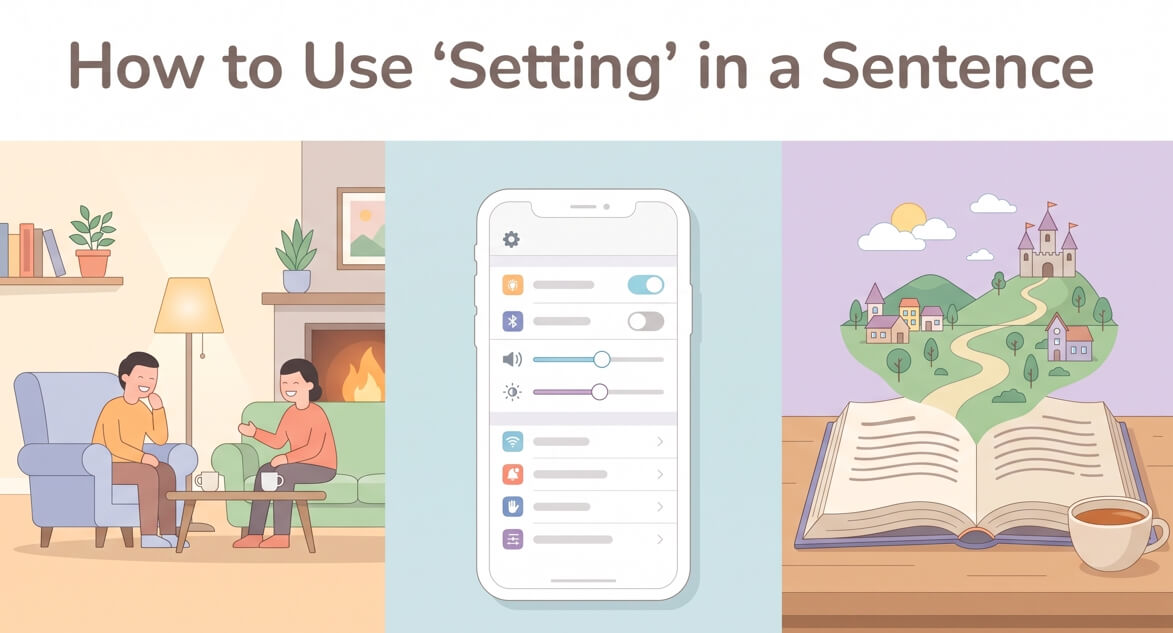
“Setting” is one of those small English words that quietly does a lot of heavy lifting. Say it in a coffee shop and you’re talking about the mood of the place. Say it on your phone and you mean a menu buried three taps deep. Say it in a book review and you mean the whole world the story lives in.
That’s exactly what trips up so many ESL learners — the spelling never changes, only the meaning does. One word, three completely different jobs, and zero warning labels.
By the end of this guide, you’ll have 50+ ready-to-use example sentences sorted by context, plus the grammar rules and word pairings that actually show up in IELTS and TOEFL writing tasks. Let’s get into it.
What Does “Setting” Actually Mean?
At its core, setting is a noun — and depending on where you find it, it usually points to one of three things:
Test paragraph.
- Item one
- Item two
- Item three
As the Cambridge Dictionary confirms this.
📌 Grammar Tip: something — else.
Para one.
“Setting” comes from “to set” — literally where something has been “set.”
- An environment or surroundings — the physical or social space around you (a formal setting, a peaceful setting).
- A configuration or option — an adjustable feature on a device or piece of software (a privacy setting, a low setting).
- The time and place of a story — where and when a book, film, or play takes place.
As the Cambridge Dictionary confirms, these three senses cover the vast majority of real-world uses of the word.
📌 Grammar Tip: “Setting” comes from the verb to set (to place something). Add -ing, and it becomes a noun describing the result of that placement — literally, where something has been “set.”
I still remember a student who insisted “setting” could only mean a place in a story — until I pointed at his own phone’s brightness slider. That’s usually the moment it clicks.
Para two with italic word.
Para three.
Examples of “Setting” in a Sentence (By Context)
Now for the part you actually came for. We’ve grouped 30+ examples by context, because a wall of random sentences — looking at you, most dictionary sites — helps nobody memorize anything.
1. Setting as a Physical or Social Environment
- He tends to be shy in social settings.
- This would be a beautiful setting for a picnic.
- The hotel lobby had the hushed setting of an old European palace.
- Interviews are a stressful setting for most candidates.
- We chose a quiet setting for the wedding vows.
- Hospitals are a strange setting to fall in love in — but it happens more than you’d think.
- The mountain village turned out to be the perfect setting for a slow, quiet retirement.
- In a professional setting, always address your manager formally.
- The classroom setting changed completely once the new desks arrived.
- Growing up in a rural setting taught her to value silence.
- The garden’s candlelit setting made the proposal unforgettable.
- Some people thrive in loud, chaotic settings; others need total calm to function.
2. Setting in Technology and Devices (Configuration)
- Go to Privacy and turn the setting off.
- Use the right setting for the job — a low heat setting won’t sear a steak, no matter how patient you are.
- I changed my phone’s brightness setting and my eyes finally thanked me.
- The washing machine has a delicate setting for wool sweaters.
- Reset the router to its factory settings if nothing else works.
- Dark mode is my default setting on every app now, no exceptions.
- The camera’s automatic setting rarely gets low light right.
- Adjust the thermostat setting before you leave for work.
- Notification settings are hidden three menus deep on most phones — as if anyone wanted you to find them easily.
- She switched the oven to the convection setting for even baking.
- Check your account settings if the emails suddenly stopped arriving.
- The default setting on most software is rarely the smartest one.
3. Setting in Literature and Stories
- The setting of Pride and Prejudice is Regency-era England.
- A dystopian setting makes a story’s warnings feel closer to home.
- The film’s setting — a small fishing town — becomes almost a character itself.
- Good writers use setting to mirror a character’s emotional state.
- The novel’s wartime setting explains why food is such a recurring symbol.
- Choosing the right setting can make or break a short story.
- The play’s setting never leaves a single, claustrophobic room — and that’s exactly the point.
Common Phrases and Collocations with “Setting”
If you’re prepping for IELTS or TOEFL, collocations like these are worth more than memorizing ten random vocabulary words. Examiners notice natural word pairings.
| Collocation | Meaning | Example |
| Default setting | The original, pre-set option | “Just restore the default setting.” |
| Privacy settings | Controls for what others can see | “Update your privacy settings today.” |
| Formal setting | A serious, professional environment | “Wear a suit in a formal setting.” |
| Beautiful setting | An aesthetically pleasing location | “It was a beautiful setting for the ceremony.” |
| Social setting | A gathering of people | “He’s quiet in social settings.” |
| Low/high setting | A device’s power level | “Cook the rice on a low setting.” |
Here’s the thing — most vocabulary apps have you memorize “setting” as a single flashcard, which is exactly why it never sticks. It isn’t one word. It’s three, wearing the same coat. Treat it that way, and IELTS Writing Task 2 gets noticeably easier.
Frequently Asked Questions (FAQs)
Use setting as a noun after an article (a/the) or a possessive, matching the context — environment, device, or story. Example: “The setting of the movie is 1920s Paris.”
In literature: “The setting of the novel is a small coastal town in winter.” In technology: “Lower the volume setting before the call starts.”
Setting is usually a noun, formed from the verb to set plus -ing. It can also work as a present participle — “The sun is setting” — but that’s a different grammatical role entirely, worth its own article.