
Finding the exact word is tough. But figuring out how to use it in a real-world sentence? That’s the actual boss fight. I remember staring at a blank screen for twenty minutes trying to make my college essay sound smart without sounding like a 19th-century philosopher.
You don’t want a boring dictionary wall of text. You want real, copy-pasteable examples to see reasoning used in a sentence naturally.
So, let’s cut the fluff. Here is your ultimate, categorized guide to seeing this word in action—whether you’re writing an academic paper, firing off a Slack message, or just trying to win an argument online.
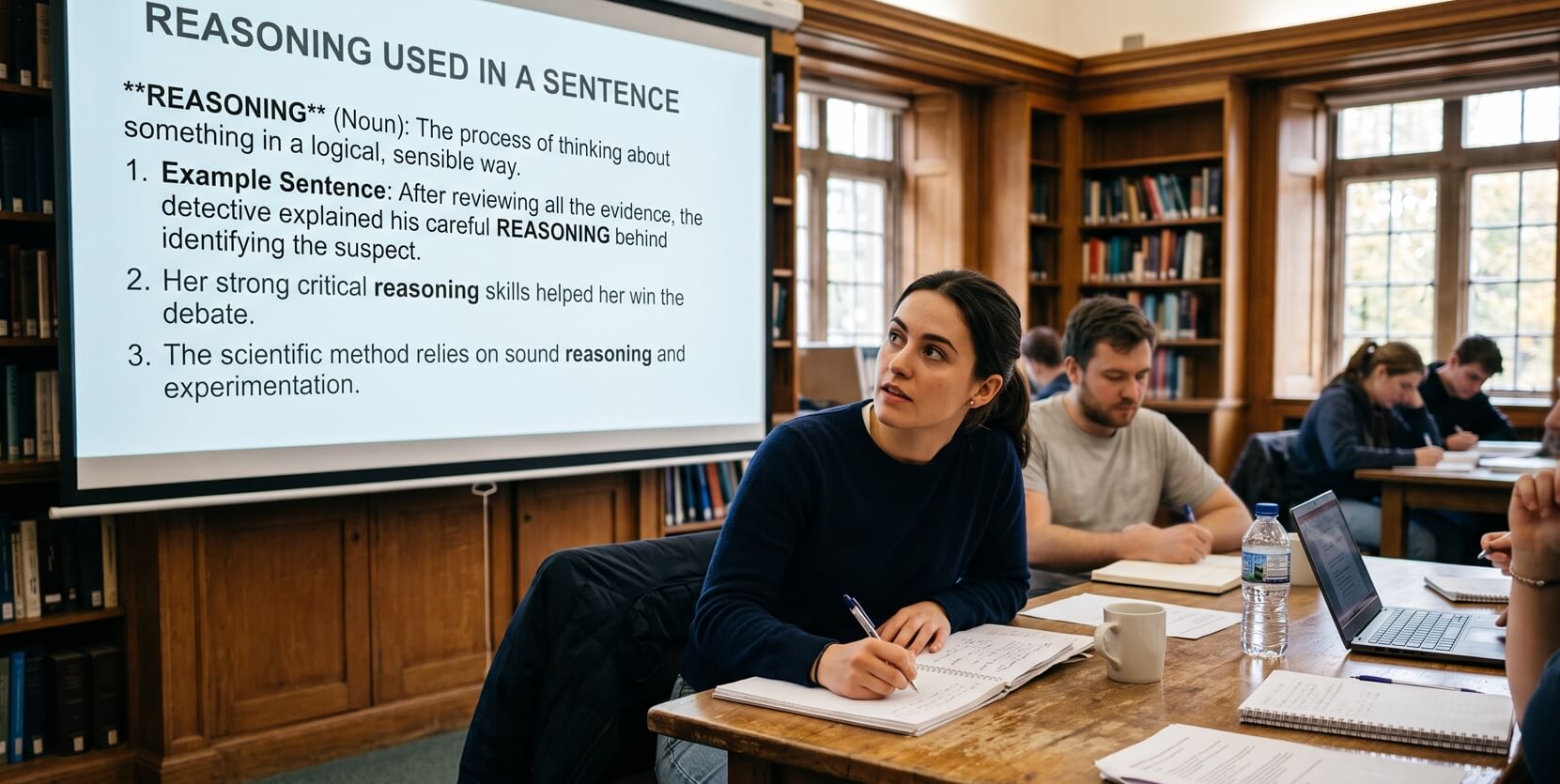
What is the Meaning of “Reasoning” with an Example?
Reasoning is the cognitive process of thinking about something in a logical, sensible way in order to form a conclusion or judgment. Simply put? It’s the “why” and the “how” behind the decisions you make.
When you use logic to solve a problem, you are applying this concept. It’s not just having an opinion; it’s having the mental math to back it up.
Let’s look at a quick, everyday example:
- “I don’t quite follow your reasoning for buying a winter coat in July, but it was on sale, so I get it.”
What are 5 Good Sentences for “Reasoning”?
If you’re just looking for the quick hits to understand the flow, I’ve got you covered. These are five flawless, everyday examples that sound 100% natural to a native speaker.
- We need to clearly explain the reasoning for this sudden schedule change to the team.
- Her reasoning was totally flawless, leaving the opposing debate team completely speechless.
- Let me walk you through my reasoning before you completely reject this wild idea.
- The detective couldn’t figure out the suspect’s reasoning for returning to the crime scene.
- Sound reasoning is the absolute foundation of any good argumentative essay.
How Do I Start a Sentence with Reasoning?
Can you actually kick off a sentence with this word? Absolutely. Usually, it functions as a gerund (a noun made from a verb) that introduces the main subject of your thought.
Starting a sentence this way gives your statement an immediate, authoritative punch. It shows you are actively analyzing a situation. Here are three ways to do it right:
- “Reasoning through this complex math problem will take some serious time.”
- “Reasoning with a toddler who wants ice cream for breakfast is a lost cause.”
- “Reasoning logically, we can assume the server crashed due to the sudden traffic spike.”
Examples of “Reasoning” in Different Contexts
Depending on who you’re writing to, your tone has to shift. A text to your best friend shouldn’t sound like a Harvard thesis.
Here are highly specific, categorized examples so you never hit the wrong note.
Short & Simple Sentences
Perfect for everyday conversation, ESL learners, or keeping things brutally brief. No complicated vocabulary here.
- I completely disagree with your reasoning.
- What is the reasoning here?
- Honestly, his reasoning makes no sense.
- Can you explain your reasoning?
- She used deductive reasoning to win.
- That is some solid reasoning.
- They immediately questioned my reasoning.
- I implicitly trust her reasoning.
- Your reasoning is a bit flawed today.
Academic & Formal Sentences
Sarcasm aside, if you need an A+ on your paper, this is your goldmine. You want to sound elevated, objective, and deeply analytical without being pretentious.
- The author’s reasoning is heavily supported by recent empirical data.
- Students must employ critical reasoning to analyze historical events properly.
- Inductive reasoning allows scientists to form hypotheses based on observations.
- The professor challenged the underlying reasoning of the student’s thesis.
- Mathematical reasoning is absolutely essential for advanced theoretical physics.
- We must carefully evaluate the ethical reasoning presented in this case study.
- The court found the legal reasoning behind the defense’s argument insufficient.
- Logical reasoning is a core component of the standard LSAT examination.
Business & Professional Sentences
For those 9-to-5 moments when you need to politely tell a coworker they are wrong—or just explain a new corporate strategy without sounding aggressive.
- Please walk the stakeholders through the reasoning for the Q4 budget cuts.
- The reasoning for this marketing pivot is based strictly on performance metrics.
- We need to document the business reasoning before approving the purchase.
- I understand your reasoning, but the ROI just isn’t there right now.
- Her strategic reasoning helped our startup secure Series B funding.
- Management’s reasoning for the strict remote work policy remains unclear.
- Let’s align on our core reasoning before we pitch this idea to the client.
- Could you clarify the reasoning behind missing the quarterly project deadline?
The Most Common Phrase: “The Reasoning Behind…”
Let me let you in on a native-speaker secret. If you want to sound 100% natural, pair this word with the preposition “behind.”
It’s the bread and butter of conversational English. We use it all the time to ask for hidden motives or context. Here is how it looks in action:
- I really don’t understand the reasoning behind your sudden decision to quit.
- What is the reasoning behind charging a premium for this basic feature?
- The reasoning behind the new app design is to improve user experience.
- She finally explained the reasoning behind her unusual investment strategy.
- Once you see the reasoning behind the strict rule, it actually makes sense.
Reasoning vs. Reason: Quick Difference
Let’s clear up a classic mix-up. People swap these two all the time, but they aren’t twins. Why use one over the other?
“Reason” is usually the cause or excuse for an event. “Reasoning” is the active process of logic used to arrive at a conclusion.
| Word | What it means | Sentence Example |
| Reason | The static cause or excuse. | Rain is the reason the game was canceled. |
| Reasoning | The logical thought process. | His reasoning for canceling the game was that lightning posed a safety risk. |
To dive deeper into the morphological roots of the word and master your vocabulary, I highly recommend checking out the Cambridge Dictionary’s linguistic breakdown for extra context.
Summary
There you have it! Mastering how to use this word doesn’t require a Ph.D. in linguistics—just the right context.
Feel free to bookmark this page, copy and paste the sentences that fit your daily needs, and keep practicing your conversational flow. You’ve got this!