
Fate (/feɪt/) is the predetermined course of events that happens outside a person’s control, as if a supernatural power or higher force had already decided the ultimate outcome. Need fate in a sentence you can actually use? Here are 60+ clear examples, sorted by level and tone. No fluff, no walls of text.
6 best sentences with fate
- I left it to fate, and honestly, it worked out.
- Nobody can change his fate.
- The court will decide the fate of the contract on Friday.
- Meeting you felt like fate.
- She accepted her fate with a smile.
- The company’s fate depends on one meeting.
Simple & Short Examples of “Fate” in a Sentence (Easy to Use)
Short on time? Copy any of these. Each one has fewer than ten words, making them easy to memorize for ESL learners or quick essays.
- Fate brought us together.
- I believe in fate.
- It was fate, not luck.
- Fate is hard to change.
- We can’t escape our fate.
- He met a sad fate.
- Fate had other plans.
- Do you trust fate?
- Her fate was sealed.
- Fate chose this day.
- Don’t tempt fate!
- The team’s fate is unclear.
- Fate can be cruel.
- I’ll leave it to fate.
- Fate smiled on us today.
How to Use “Fate” in a Sentence (Grammar & Collocations)
“Fate” is a noun (often associated with fortune or destiny), and it usually works as the subject or the object of a sentence. Learn the verbs and phrases that travel with it naturally, and you’ll sound like a native speaker right away.
Common Verbs Used with Fate
In everyday English, these five verbs cover about 90% of real conversations. Here is each one in action:
Seal means to make an inevitable outcome final and impossible to undo.
- That one late payment sealed his fate at the bank.
- A single bad answer sealed her fate in the interview.
Accept means to stop fighting an outcome you can’t change.
- After months of struggle, he finally accepted his fate.
- Some people accept fate; others argue with it until midnight.
Decide is used when something or someone determines the outcome.
- The final vote will decide the fate of the school.
- A coin flip decided our fate, which is a terrible way to run a business.
Tempt means to take an unnecessary risk, as if daring bad luck to show up.
- Driving that fast in the rain is tempting fate.
- Don’t tempt fate by skipping the safety check.
Leave to means to stop controlling the result and let events play out.
- I did my best on the exam, so I’ll leave the rest to fate.
- They left the decision to fate and booked a one-way ticket.
Popular Idioms & Phrases with Fate
These four phrases show up everywhere, from novels to news headlines. For a deeper breakdown of grammatical idioms, you can check the Cambridge Dictionary.
A twist of fate is an unexpected event that changes everything.
- By a twist of fate, we sat next to each other on the train.
- A twist of fate turned a missed flight into a new job.
A quirk of fate is a strange, almost funny coincidence.
- By a quirk of fate, the twins ended up at the same university.
- It was a quirk of fate that the lost keys were in my coat all along.
A fate worse than death is an exaggeration for something awful. Use it with a wink.
- Sitting through another four-hour meeting felt like a fate worse than death.
- For a teenager, losing your phone is a fate worse than death.
In the hands of fate means the outcome is completely out of your control.
- The rescue mission is now in the hands of fate.
- With the storm closing in, our trip was in the hands of fate.
Can You Use “A Fate” in a Sentence? (Countable vs. Uncountable)
Here is the grammar rule: Usually, “fate” takes no article (“I believe in fate”). But the moment you add an adjective that describes the specific type of outcome, you must use “a”.
- He met a tragic fate at sea.
- It was a cruel fate for such a kind man.
- She deserved a better fate.
No adjective = no article. Adjective = add “a.”
Examples of “Fate” by Context (Literature, Drama & Daily Life)
Ready to level up? These sentences are for essays, creative writing, and anyone who wants to sound sharper than a basic dictionary.
Dramatic & Literary Sentences with Fate
- No matter how far he ran, fate was always one step ahead.
- The prophecy hung over the kingdom like a storm, and no one could outrun their fate.
- She stared at the letter, knowing her fate was written in every line.
- Two strangers, one rainy night, and a fate neither of them expected.
- He fought fate with everything he had, and fate simply shrugged.
- The hero’s tragic fate was clear from the first chapter.
- In the end, they surrendered to fate and watched the sun go down.
- Was it love, or was it just fate playing cruel games?
- The villain believed he could rewrite his own fate, and that was his mistake.
- Their love story was written by fate, then torn apart by pride.
News, Formal & Daily Life Sentences
- The fate of the missing hikers remains unknown.
- The judge will announce the fate of the defendant on Monday.
- Investors are anxiously waiting to learn the fate of the merger.
- The city council will determine the fate of the old stadium.
- “I can’t control the market,” he said. “It’s up to fate now.”
- Thousands of workers are facing an uncertain fate after the factory closed.
- My brother says missing that bus was fate; I say it was a lazy alarm clock.
- Some patients feel they’ve been handed a bad fate, and that feeling deserves respect.
- The committee has sealed the fate of three major projects.
- Honestly, blaming fate for a late assignment won’t impress your professor.
“Fated” in a Sentence (Verb & Adjective Examples)
Fated means destined to happen in a specific, unavoidable way. You’ll often see it in the structure “be fated to + verb.” Here is how to use fated in a sentence:
- They were fated to meet.
- The ship was fated to sink on its first voyage.
- She felt fated to become a teacher, just like her mother.
- Their fated reunion happened in an airport at 3 a.m.
- He was never fated to win, but he kept trying anyway.
- Maybe we were fated to disagree about everything.
- The fated day finally arrived, and nobody slept.
Fate Meaning vs. Destiny: How They Differ in a Sentence
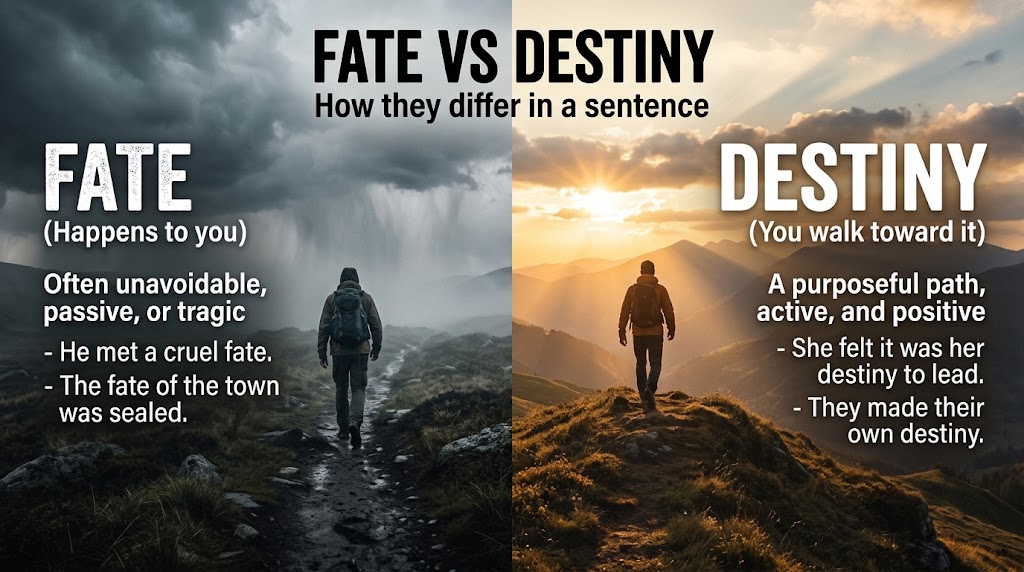
While often used as synonyms, there is a distinct difference in tone. Fate is usually inevitable, already decided, and often carries a negative or tragic weight. Destiny, on the other hand, is a purposeful path where you take an active part, and it tends to feel positive or heroic.
My take? Use “fate” when something happens to you. Use “destiny” when you’re walking toward something.
| Fate (Happens to you) | Destiny (You walk toward it) |
| He met a cruel fate in the war. | She felt it was her destiny to lead. |
| The fate of the town was sealed. | He chased his destiny all the way to Hollywood. |
| We can’t escape our fate. | They made their own destiny. |
Frequently Asked Questions (FAQs) About Using “Fate”
Fate is the concept that an invisible, supernatural power controls what will happen in the future, and humans cannot stop it. For example: “It was fate that we met.” Many people use the word to explain unavoidable big life events, both good and bad.
An example of fate is meeting the love of your life by pure chance or missing a train that later crashes. In both cases, people feel the events were predetermined for them, saying things like: “Fate saved my life that day.”
“Your fate” means the final outcome, judgment, or consequence that waits for you personally. It can refer to a judge’s verdict or the ultimate result of your own choices. For example: “The jury will decide your fate tomorrow.”
In human life, fate is a belief system used to make sense of outcomes people cannot control, such as loss, extreme luck, or sudden change. It offers comfort when life feels random. For example: “I lost the job, but maybe it was fate.”