


The word religion is a noun that refers to a system of spiritual beliefs, worship, and moral practices, usually centered on a higher power, deities, or an ultimate truth.
Here is religion in a sentence ready to use:
Many people turn to religion for comfort, guidance, and hope during challenging times.
Below, you’ll find 50+ real-world examples of religion in a sentence, categorized by context so you can find the exact match for your essay, speech, or grammar exercise. Understanding the meaning for religion first makes every sentence pattern intuitive and easy to apply.
Easy Examples of “Religion” in a Sentence
Start simple. These everyday examples of religion used in a sentence work for any grade level. If you want to learn how to use religion in a sentence cleanly, keep the subject direct and let the context explain itself:
- She has studied world religions for several years.
- Freedom of thought and religion is guaranteed by law.
- They treat each other with respect regardless of race or religion.
- His religion places a strong emphasis on charity and kindness to strangers.
- My grandmother’s religion shapes how our family celebrates the holidays.
- The museum features an exhibit on the history of religion in ancient Egypt.
- What religion is primarily practiced in that mountain village?
- Our teacher asked us to write an essay about the role of religion in daily life.
- World religion was my favorite topic in high school history class.
- He prefers to keep his religion separate from his professional career.
- Every major religion observes its own sacred dates and traditions.
- She wrote a persuasive speech on the connection between religion and classic art.
- Ancient societies used religion to explain natural phenomena like thunder and eclipses.
- Learning about another person’s religion fosters mutual understanding.
The third example “regardless of race or religion” is one of the most frequent collocations in formal English. You will encounter it repeatedly in legal statutes, academic papers, and job equality statements.
How to Use “Religion” by Context and Meaning
The word religion generally operates under two primary meanings: its literal definition (faith and spiritual systems) and its informal figurative sense (extreme devotion).
Formal Belief Systems: Literal Meaning
In academic, journalistic, and formal contexts, the religion word represents organized belief systems, sacred doctrines, and communal creeds:
- Comparative religion classes help students evaluate global perspectives objectively.
- Shinto is an indigenous religion that originated in Japan.
- Archaeologists discovered early cultural evidence of prehistoric religion in cave paintings.
- The nation’s official state religion underwent fundamental changes across the centuries.
- Anthropologists frequently study how religion originally emerged to unite human communities.
- Christian religion exerted enormous influence over medieval European architecture and governance.
- Many families consciously pass their ancestral religion down through successive generations.
- Sociologists observe how organized religion shapes public morality and civic engagement.
Figurative Use: Strong Devotion or Passion
In casual conversation, English speakers often use religion metaphorically to describe an activity, routine, or hobby that someone pursues with unwavering discipline:
- In the southern United States, high school football is treated practically as a religion.
- Clean eating and cross-training became a daily routine that bordered on religion for him.
- For our family, gathering for Sunday afternoon dinner is an untouchable religion.
- She makes an absolute religion out of her morning espresso and journaling ritual.
- Among sneaker collectors, tracking limited release dates is treated like a religion.
- For experienced distance runners, the Saturday morning twenty-mile run is a sacred religion.
- Technology enthusiasts follow company keynote addresses with the fervor of a new religion.
“Freedom of Religion” in a Sentence (Legal and Civic Context)
In American English, this phrase explicitly links to constitutional rights and the First Amendment:
- Freedom of religion is a foundational pillar enshrined in the First Amendment of the U.S. Constitution.
- Early European settlers sailed across the Atlantic largely to secure freedom of religion without state persecution.
- The Supreme Court ruled that the municipal policy directly violated the plaintiff’s freedom of religion.
- Federal employment regulations strictly protect workers from harassment based on their freedom of religion.
- Public school students retain the constitutional right to private prayer under the protection of freedom of religion.
- The principle of freedom of religion equally safeguards an individual’s right to practice no religion whatsoever.
Grammar Rules: How to Use “Religion” Correctly
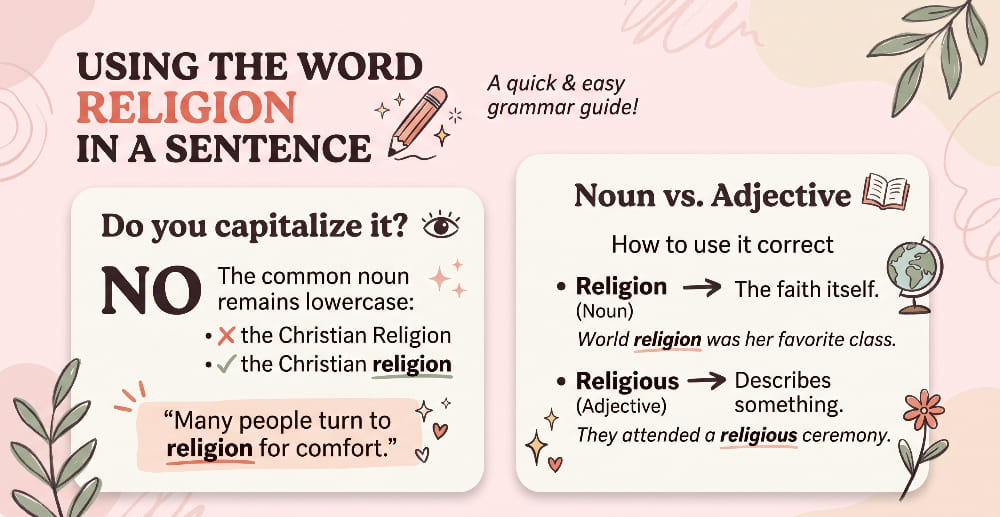
Do You Capitalize Religions in a Sentence?
This is one of the most common punctuation inquiries among writers. The rule is straightforward:
- The common noun religion remains lowercase unless it is the very first word of a sentence or appears within an official title.
- Specific names of belief systems are proper nouns and are always capitalized: Christianity, Islam, Judaism, Buddhism, Hinduism, Sikhism.
- Incorrect: He decided to study the Christian Religion in college.
- Correct: He decided to study the Christian religion in college.
- Incorrect: Is Islam considered an Abrahamic Religion?
- Correct: Is Islam considered an Abrahamic religion?
Difference Between “Religion” (Noun) and “Religious” (Adjective)
Knowing how to adapt the root word into different parts of speech prevents clumsy syntax. While religion is the institution or concept itself, religious describes attributes related to that faith:
| Word | Part of Speech | Function | Example in a Sentence |
| Religion | Noun | The entity, faith, or concept | Organized religion plays a measurable role in modern community building. |
| Religious | Adjective | Modifies a person, object, or event | They gathered to attend an official religious ceremony on Saturday morning. |
| Religiously | Adverb | Describes an action done devoutly or consistently | She reviews her vocabulary flashcards religiously before every exam. |
Want to expand your vocabulary and perfect your pronunciation? Watch this quick guide by a native English teacher on how to use religion-related words correctly in everyday conversation:
10 Major World Religions in One Sentence
When summarizing world cultures, concise synthesis is essential. Here are ten foundational faiths, each defined clearly within a single sentence:
- Christianity is the world’s largest religion, centered around the life, crucifixion, and resurrection of Jesus Christ.
- Islam is a major monotheistic religion whose adherents, called Muslims, follow the divine teachings of the Quran revealed through the Prophet Muhammad.
- Hinduism is an ancient dharma and religion originating in South Asia, characterized by diverse traditions, karma, and rebirth.
- Buddhism is a non-theistic religion and philosophy founded by Siddhartha Gautama that focuses on mindfulness, ethical conduct, and the cessation of suffering.
- Judaism is an ancient monotheistic religion founded on the covenant between God and the Jewish people as documented in the Hebrew Bible (Torah).
- Sikhism is a monotheistic religion originating in the Punjab region that advocates social equality, selfless service, and meditation upon the divine name.
- Shinto is a spiritual religion native to Japan centered on venerating spirits known as kami within the natural world.
- Taoism is an ancient Chinese religion and philosophy emphasizing simplicity, naturalness, and effortless living in balance with the Tao.
- Jainism is an Indian religion centered on strict nonviolence (ahimsa), spiritual purity, and truthfulness toward all sentient life.
- The Baha’i Faith is a modern global religion that emphasizes spiritual unity, the oneness of humanity, and the harmony of science and faith.
Frequently Asked Questions
A religion is an organized framework of core beliefs, moral principles, and ritual practices centered around spiritual truths or a supreme creator. For instance, Buddhism serves as a classic example of a major world religion focused on moral discipline, meditation, and inner enlightenment.
In plain words, religion is a shared worldview that unites communities, explains our existence in the universe, and gives individuals moral direction through time-tested traditions and rituals.
You use religion as a standard noun acting as a subject, object, or prepositional complement in your phrase. For example: “Education should be made accessible to every student regardless of their background or personal religion.”
Yes, because the English word sentence has multiple meanings (a grammatical statement vs. a judicial punishment). In a legal scenario, you can write: “The incarcerated individual requested visits from a minister of his chosen religion before the judicial death sentence was reviewed.”
Mastering religion in a sentence comes down to keeping your grammatical agreement clean and matching your tone to either literal faith or metaphorical dedication. With these models in hand, you can navigate essays, historical papers, and everyday discussions with clarity and precision.